
Avenue Canada Launches Canada-Wide Search for Employment-Focused Language Training Resources
Avenue Canada Solutions launches a Canada-wide initiative to identify and share employment-focused language training resources for newcomers to Canada.

Technology continues to change how adult newcomers learn English, but successful Technology-enhanced Language Learning depends on much more than digital tools. It requires thoughtful teaching, opportunities for meaningful interaction, and instructors who feel confident enough to experiment, reflect, and ask questions.
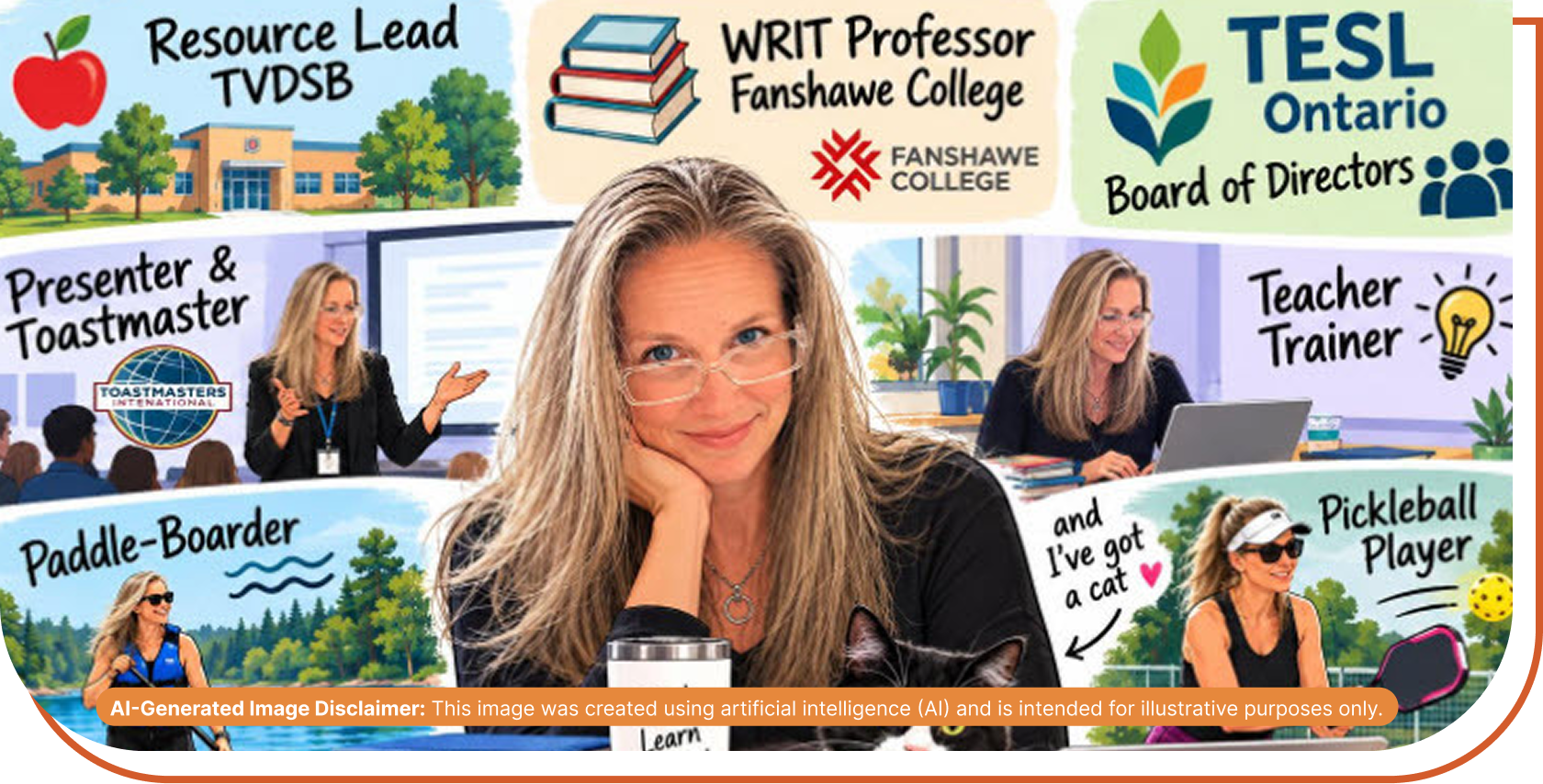
Jennifer Artan brings these perspectives together in her work as Lead Instructor at the Thames Valley District School Board (TVDSB) and as an Avenue Mentor. Through her mentoring and teacher training, she helps instructors move beyond the technical aspects of Avenue.ca to explore how digital learning environments can support engagement, independence, and language development.
In this interview with John Allan, Senior Avenue Developer and Mentor, Jennifer discusses the changing needs of Avenue instructors, the successes of TVDSB’s asynchronous Anytime classes, the importance of learner analytics, and the opportunities and risks associated with generative artificial intelligence (GenAI). Throughout the conversation, she returns to a central theme: technology is most valuable when educators understand why they are using it and how it contributes to learning.
In this spotlight conversation, Rob McBride speaks with Nancy Van Dorp, Avenue Canada’s Distributed Learning Manager and one of the organization’s most experienced learning technologists and e-developers.
Jennifer, you’ve worked with instructors who have very different levels of experience and confidence with educational technology. As an Avenue mentor, what have you learned about the support teachers need most?
I think the most important thing is remembering that not everyone is on the same page when it comes to using new learning technologies. As mentors and teacher trainers, we can sometimes forget that.
Some instructors are very comfortable experimenting with technology, while others need more reassurance, time to explore, practical examples, and individualized support.
One of our overarching objectives is to help instructors know what to do when they don’t know what to do. But they also need to know that they can reach out and ask questions. They shouldn’t feel that they have to figure everything out on their own.
I spend a lot of time thinking about the why, especially in my mentoring role. Why are we asking an instructor to complete a particular task during training? What is the purpose? What will they learn from it?
Avenue training was developed by educators for educators. Each step in the training process is an opportunity to learn something that can be applied in the classroom.
That idea of understanding the purpose behind a task seems important. How does it influence the practical support you provide?
It means looking beyond the mechanics of using Avenue.
For example, I might help an instructor understand how to use their Avenue course space more effectively or how to find and curate resources that suit their learners. We might look at how Universal Design for Learning, or UDL, principles can inform the way activities are organized and presented. It’s not simply a matter of showing someone where to click. It’s helping them understand how the learning environment can work for them and their students. Sometimes that means providing a practical example. Sometimes it means giving someone the reassurance and time they need to experiment.
I want instructors to recognize that the training process itself has value. When they understand why they’re completing a particular task, they’re better positioned to make their own decisions later.
Has the nature of those mentoring conversations changed as instructors have become more experienced with Avenue and blended learning?
Definitely. Instructors are increasingly looking for ways to make their online activities more engaging and relevant.
Earlier, the focus might have been on getting learners to log in, navigate the course, and find the correct topic. Those are important skills, of course, but now the conversation is much more about making effective use of the resources that are available. Instructors are asking what they can do with those resources and how they can use them to create meaningful learning opportunities. One development I find particularly encouraging is that instructors are creating their own H5P activities to meet the specific needs of their learners. That’s fantastic! H5P allows teachers to develop interactive learning activities, and creating their own gives instructors more opportunities to adapt content to their particular classes.
You have also emphasized the importance of reusing learning materials rather than continually creating something new. Why does that matter?
Because we can use, and reuse, material in many different ways.
John Sivell wrote about something he called “going back to the well.” The idea is that learners benefit from returning to the same oral or written text and examining it from different perspectives.
I think that’s a really valuable reminder for language teachers. We don’t necessarily have to introduce completely new content every time we want learners to practise another skill or notice another language feature. A single resource can support different learning activities and give learners opportunities to revisit meaningful language. It’s about making thoughtful use of what we already have, rather than assuming that more resources automatically mean better learning.
Thames Valley District School Board has been developing some interesting approaches to online learning. One example is its Anytime classes. How do they work?
Our Anytime classes are entirely online, with learners working at their own pace. They’ve been quite successful, and I think an important reason is that our instructors understand the value of three different kinds of presence in an online learning environment: social presence, teaching presence, and cognitive presence.
These ideas are especially important in asynchronous learning, where students aren’t necessarily studying at the same time.
We need to think carefully about how learners experience the course, how they interact with other people, and how the instructor supports their learning.
One concern about asynchronous learning is that students may feel isolated. How are your instructors addressing that?
That’s where social presence becomes so important.
Because learners are studying at different times, they can feel disconnected from their classmates. Our instructors use group forums and live chat tools to help develop a sense of community. For example, learners might be asked to post a response to a discussion question and then engage with several classmates’ responses. That creates opportunities to practise functional, real-world communication skills, but it also helps learners get to know one another.
One thing we’ve noticed is that learners are quite keen to hear what their classmates think. They look forward to reading and responding to those contributions. That’s an important part of creating community, even when everyone isn’t online at the same time.
And what about the instructor? How do learners know their teacher is present when much of the work happens independently?
Our Anytime courses have weekly teacher office hours. Learners can drop into a synchronous Google Meet session to ask questions or get help.
But teacher presence is much more than being available for a scheduled meeting. Throughout the course, instructors review learner work, provide formative feedback, and participate in the discussion forums. Those ongoing interactions matter. They demonstrate that the instructor is paying attention to the learners’ work and is actively involved in the learning process. The course may be asynchronous, but that doesn’t mean the teacher is absent.
The third element you mentioned was cognitive presence. How does Avenue help teachers understand what’s happening with learners in that area?
This is one of the areas where I think Avenue provides some of its most useful insights. Avenue has learner analytics that allow teachers to look more closely at how students are interacting with their courses. The analytics themselves don’t create cognitive presence, but they provide information that can help instructors understand the learning experience. Teachers can see when learners have logged in, where they’ve spent time, and how they’re engaging with different resources, including forums, H5P activities, and videos. That gives instructors a much more nuanced view of what is happening than simply knowing whether someone has completed an activity.
So, the data can help teachers make decisions about the course itself?
Exactly. Instructors can use that information as they consider how learners are reflecting, discussing, and applying what they’ve learned. It helps them see how different resources are being used and where they might want to look more closely. Our teachers are also taking advantage of Avenue’s Course Builder to customize module topics for their classes. They’ve recently added some of the new AI units, and I’m particularly interested to see what happens in the discussion forums when learners begin exploring those topics.
That brings us naturally to generative AI. There’s a great deal of interest in what these tools might mean for language teaching. Where do you see the most exciting opportunities?
I often think about the SAMR model: Substitution, Augmentation, Modification, and Redefinition. It’s the redefinition part that I find most exciting.
That’s where technology makes it possible to create learning experiences that would previously have been difficult or impractical. I think GenAI has considerable potential in that area, although there are also possible pitfalls.
Can you give us an example of the kind of redefinition you’re talking about?
I know colleagues who are stepping outside their usual areas of expertise and using GenAI to help write code. For example, one instructor might create a virtual ATM for a literacy class. Instead of simply reading instructions about banking, learners can practise interacting with a simulated machine.
Another example is a virtual parent portal, designed for learners who have children in elementary school. The simulation allows parents to practise finding information they might need, such as permission forms or details about class trips. These are practical, relevant learning opportunities.
What’s interesting is that teachers who wouldn’t necessarily consider themselves programmers are finding ways to create these kinds of resources.
Those examples are quite different from simply asking AI to generate a worksheet.
Yes, and that’s what makes them interesting.
The focus isn’t just on producing content. It’s on creating opportunities for learners to practise meaningful tasks. Another example is the use of tools such as ElevenLabs to create two-person dialogues. Teachers can generate unique dialogues very quickly. We could certainly create recorded dialogues before GenAI, but it was much more time-consuming.
Now instructors have new ways to develop materials that respond to particular classroom needs. I think the important question is what these tools allow us to do that genuinely improves the learning experience.
You’ve described some exciting possibilities, but you’ve also mentioned potential pitfalls. What concerns you most about the growing use of GenAI?
Trust. More specifically, how much trust is appropriate? There’s a problem if we trust GenAI too much, but there’s also a problem if we don’t trust it enough. If we trust it too much, we may stop checking what it produces. That’s automation bias. If we trust it too little, we may miss opportunities to improve our materials or grow as educators.
Automation bias is a term that teachers may be hearing more frequently. Why do you think it needs explicit attention?
Because GenAI can produce something that looks entirely plausible but still contains errors, bias, or misleading information. I think this is something we need to teach explicitly to both instructors and learners. Just because the response is well written doesn’t mean it’s accurate.
The BBC conducted research examining how several AI tools summarized news stories. One of the reported findings was that 45% of the AI-generated answers contained at least one significant issue. There were also examples of tools introducing editorial judgments into news reporting that had originally been neutral. That’s concerning because people can easily assume that a polished summary is a reliable one.
For language instructors who are beginning to create their own AI-assisted materials, what does that mean in practice?
It means we still need to exercise professional judgment. Whenever someone creates new materials, there’s a risk of including incorrect, biased, or outdated information. GenAI doesn’t remove that responsibility.
Instructors may learn how to enter prompts and generate resources, but that’s only the beginning. They need to check what the tools produce and think carefully about whether the results are appropriate for their learners. They also need to understand privacy and data protection. How is their information being used? What happens to the material they enter into a tool? How do they protect their learners’ data?
Those questions are just as important as knowing how to generate an activity.
Does this change the kinds of questions Avenue Mentors should be encouraging instructors to ask?
I think it reinforces the importance of asking why we’re using a particular tool. We need to consider both its potential and its limitations. There’s a broader conversation about trust in AI taking place across Canada. Trust is an important consideration in Canada’s national approach to artificial intelligence, and Canadians have shown relatively low levels of willingness to trust these technologies compared with people in some other countries.
For educators, the challenge is to develop a thoughtful, informed approach. We shouldn’t accept everything a tool produces without questioning it, but neither should we automatically dismiss something that might have educational value.
As you look at the changes taking place in Technology-enhanced Language Learning, what do you think instructors should be paying particular attention to?
I think we’re beginning to reconsider what actually goes into the tools, resources, and materials we use with our learners. Provenance and ethical use have never been more important. We need to think about where information comes from, whether we can trust it, and how we are using it. That’s particularly relevant with GenAI, but it also connects to the broader work instructors are doing with digital learning.
We have to make thoughtful choices about our materials, how we use them, and the learning opportunities we create.
You’ve talked about the importance of purpose, community, feedback, and critical judgment. Do you see a common thread running through all these areas?
I think it comes back to looking beyond the resources themselves. Avenue instructors are building more than just their courseware. They’re building roadmaps of learning opportunities. It’s about considering how learners interact with materials, with their instructors, and with one another. It’s also about thinking carefully about why we select particular activities and what we hope learners will gain from them. Whether we’re talking about an online discussion, an H5P activity, learner analytics, or a new GenAI tool, those are the questions that matter.
Finally, what encourages you most about the instructors you’re working with?
I’m glad that mentees are asking the tough questions. Someone has to. And I think those questions are especially important as we continue to wrap our minds around new tools and new possibilities.
This interview has been edited for length, clarity, and readability. Generative AI was used to help organize the discussion thematically, refine questions, and condense responses. The interviewee’s views, experiences, and intended meaning have been preserved.
1. Sivell, J. (2012). Contact Magazine. TESL Ontario.
2. BBC Media Centre. (2025). New EBU Research on AI Assistants and News Content.

Avenue Canada Solutions launches a Canada-wide initiative to identify and share employment-focused language training resources for newcomers to Canada.

Explore Dr. Geoff Lawrence’s perspective on the changing landscape of language education, the role of AI and technology, and why human connection and pedagogy must remain at the centre of

Meet Dr. Matthias Sturm and explore his journey with Avenue, from early online learning research to evaluation, technology and newcomer settlement.

Meet Nancy Van Dorp and discover her journey with Avenue, from building meaningful connections to embracing change and technology throughout her career.
Nancy Van Dorp’s career demonstrates something she continues to encourage in the instructors she supports: learning technology expertise develops gradually.