
Rob
John, let’s start with the basics. What do you do on the Avenue Project?

John
“Basics” might be generous! My work is layered. First and foremost, I’m on the Avenue Support Desk about 18 hours a week. That means I interact daily with instructors and administrators across Canada. Some questions are simple – navigation, setup, features. Others are more complex technical or pedagogical issues.
If something can’t be resolved immediately, it goes into our ticketing system and is reassigned to the appropriate specialist. I also address many of the UserSnap reports that come in directly from teachers inside their Moodle environment. That gives us incredibly valuable insight into real classroom challenges.
Beyond that, I support our Manager of Distributed Learning in handling direct support emails. If an issue requires deeper technical access, it goes to our lead technology support. But often, I connect directly with teachers and work through the issue collaboratively.
If something can’t be resolved immediately, it goes into our ticketing system and is reassigned to the appropriate specialist. I also address many of the UserSnap reports that come in directly from teachers inside their Moodle environment. That gives us incredibly valuable insight into real classroom challenges.
Beyond that, I support our Manager of Distributed Learning in handling direct support emails. If an issue requires deeper technical access, it goes to our lead technology support. But often, I connect directly with teachers and work through the issue collaboratively.
Rob
So you’re both frontline support and a system architect in many ways.
John
Exactly. Support isn’t separate from innovation. The questions teachers ask drive improvement. When we see the same issue repeatedly, it tells us something needs to evolve – whether that’s documentation, training, or platform enhancement.
Rob
You’re also mentoring teachers through the Avenue training stages. Tell us about that work.
John
I mentor instructors from Stage 1 through Stage 4. Stage 4 is particularly exciting – that’s where teachers really begin to experiment creatively with Moodle tools and third-party integrations. You see them move from competence to innovation.
But the earlier stages are equally rewarding. In Stage 2 and Stage 3, you witness growth in confidence. You see instructors’ courses evolve – not just in appearance, but in how effectively they serve learners.
It’s not a quick process. Completing all four stages can take a year or more. But that’s real growth – not rushing through modules but developing leadership capacity.
But the earlier stages are equally rewarding. In Stage 2 and Stage 3, you witness growth in confidence. You see instructors’ courses evolve – not just in appearance, but in how effectively they serve learners.
It’s not a quick process. Completing all four stages can take a year or more. But that’s real growth – not rushing through modules but developing leadership capacity.
Rob
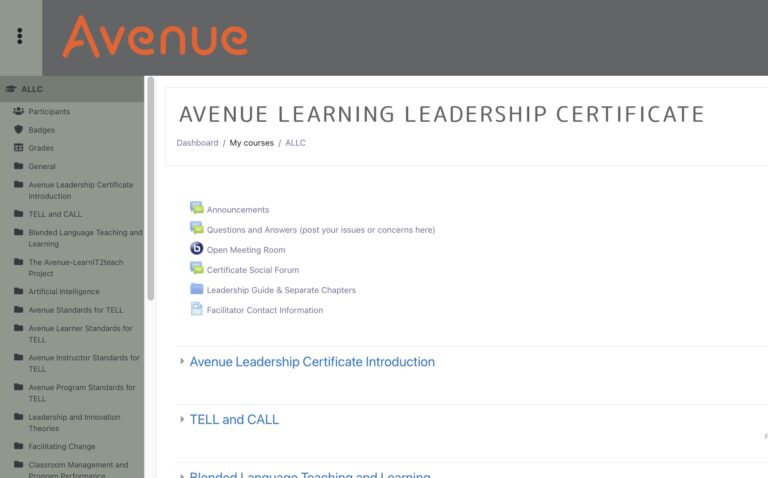
You also manage the Avenue Learning Leadership Courses, and mentor leaders through the modules. Many graduates of the Leadership courses are now sector leaders.
John
That’s one of the most gratifying parts. We see former mentees presenting at conferences, publishing, leading innovation at their institutions. They’ve become champions of Technology Enhanced Language Learning across the settlement language training sector in Canada.
And what’s remarkable is that some grads are returning to take the updated Leadership courses again – because the technology landscape and the courses have evolved significantly. The last decade brought enormous change – mobile learning, MOOCs, blended learning, then COVID-19, and now generative AI.
The Leadership courses must reflect what is actually happening in classrooms across Canada. That means constant revision. We’ve updated modules, refreshed content, re-recorded interviews, integrates segments of Avenue webinars and integrated new podcast material from the LearnIT2teach Podomatic series.
When we first created the podcast content years ago, it was timely and relevant. But the pandemic and the rise of AI required new conversations. So we re-interviewed experts and embedded those insights directly into the courses.
It’s rewarding because it ensures we’re not static. We’re evolving alongside the sector.
And what’s remarkable is that some grads are returning to take the updated Leadership courses again – because the technology landscape and the courses have evolved significantly. The last decade brought enormous change – mobile learning, MOOCs, blended learning, then COVID-19, and now generative AI.
The Leadership courses must reflect what is actually happening in classrooms across Canada. That means constant revision. We’ve updated modules, refreshed content, re-recorded interviews, integrates segments of Avenue webinars and integrated new podcast material from the LearnIT2teach Podomatic series.
When we first created the podcast content years ago, it was timely and relevant. But the pandemic and the rise of AI required new conversations. So we re-interviewed experts and embedded those insights directly into the courses.
It’s rewarding because it ensures we’re not static. We’re evolving alongside the sector.
Rob
And we offer both Introductory and Advanced Leadership courses.
John
Yes, and they’re meaningfully different from earlier versions. That’s why past graduates are returning. They’re driven professionals who understand that leadership in edtech requires continuous learning.
Rob
You and I were both involved in developing Avenue Standards for Technology Enhanced Language Learning. What was that experience like for you?
John
Honestly, it was surreal. Years ago, while working overseas, I read the TESOL Technology Standards developed by global leaders like Deborah Healey, Phil Hubbard, and Greg Kessler. Those documents were foundational in my early career.
Then suddenly, I was sitting in online meetings with those same people – collaborating on standards that would shape practice here in Canada. It was humbling.
Then suddenly, I was sitting in online meetings with those same people – collaborating on standards that would shape practice here in Canada. It was humbling.
Rob
And Sharon Rajabi helped ground that work in the Canadian settlement context.
John
Absolutely. Sharon brought deep knowledge of the Canadian system – through her administrative work and leadership in TESL Ontario. The global expertise was essential, but Sharon ensured relevance to our settlement language training realities.
It was one of those rare moments where global leadership and local practice truly aligned.
It was one of those rare moments where global leadership and local practice truly aligned.
Rob
Let’s shift to something new: Nexus. What are your initial thoughts?
John
I’m excited by the idea of moving innovation to the “shop floor,” as I like to say – the human side. Nexus has the potential to empower individual service provider organizations to adapt Avenue resources in ways that truly fit their context.
The key is partnership. We don’t dictate expectations. Centres adapt resources, set goals collaboratively, and define success based on their own realities.
If done well, Nexus could integrate beautifully with the Leadership courses. Graduates could become local innovation leaders within their organizations.
The key is partnership. We don’t dictate expectations. Centres adapt resources, set goals collaboratively, and define success based on their own realities.
If done well, Nexus could integrate beautifully with the Leadership courses. Graduates could become local innovation leaders within their organizations.
Rob
That’s certainly the direction I envision.
John
It makes sense. Leadership graduates already have the mindset. Nexus could give them a structured environment to lead ongoing innovation locally.
Rob
How did your education and previous career prepare you for this role?
John
It’s been a long path. I began as a Bachelor of Science student in 1982, shifted into TESL, earned multiple education degrees, completed a Master’s in Computer-assisted Language Learning, and another in Distance Education.
My early teaching career included discovering a locked, unused language lab at a college. A colleague and I cleaned it up, revived it, and got teachers using it again. That experience set the tone for my career – if technology exists but isn’t being used, figure out why and fix it.
I went on to train teachers in CALL labs, teach multimedia at Niagara College, work six years in Abu Dhabi, and fifteen years in Qatar. Along the way, I’ve delivered over 100 webinars and nearly 200 conference presentations in educational technology.
But what matters most isn’t the numbers – it’s that the thread has always been the same: empowering teachers to use technology meaningfully.
My early teaching career included discovering a locked, unused language lab at a college. A colleague and I cleaned it up, revived it, and got teachers using it again. That experience set the tone for my career – if technology exists but isn’t being used, figure out why and fix it.
I went on to train teachers in CALL labs, teach multimedia at Niagara College, work six years in Abu Dhabi, and fifteen years in Qatar. Along the way, I’ve delivered over 100 webinars and nearly 200 conference presentations in educational technology.
But what matters most isn’t the numbers – it’s that the thread has always been the same: empowering teachers to use technology meaningfully.
Rob
What motivates you today?
John
It’s embedded in Avenue’s mission. I love creating digital learning experiences. When we build something well – thoughtfully and collaboratively – it has reach. It’s used across Canada. It helps learners build language skills, integrate, and move forward in their lives.
That’s powerful.
And the Avenue team itself is remarkable. There’s a sense of shared purpose. People join and stay because they believe in the work.
That’s powerful.
And the Avenue team itself is remarkable. There’s a sense of shared purpose. People join and stay because they believe in the work.
Rob
Any final thoughts for professionals in the settlement language training sector?
John
We’re in a period of turbulence with generative AI. My message is simple: use it, but use it wisely.
Stay informed. You don’t need to read every article, but you do need to understand what tools you’re using. Use AI ethically, fairly, and productively. Be aware of its limitations and implications.
Technology has always brought disruption. The key is not fear – it’s informed, responsible engagement.
If we approach AI the same way we’ve approached every other technological shift – thoughtfully and collaboratively – we’ll be fine.
Stay informed. You don’t need to read every article, but you do need to understand what tools you’re using. Use AI ethically, fairly, and productively. Be aware of its limitations and implications.
Technology has always brought disruption. The key is not fear – it’s informed, responsible engagement.
If we approach AI the same way we’ve approached every other technological shift – thoughtfully and collaboratively – we’ll be fine.